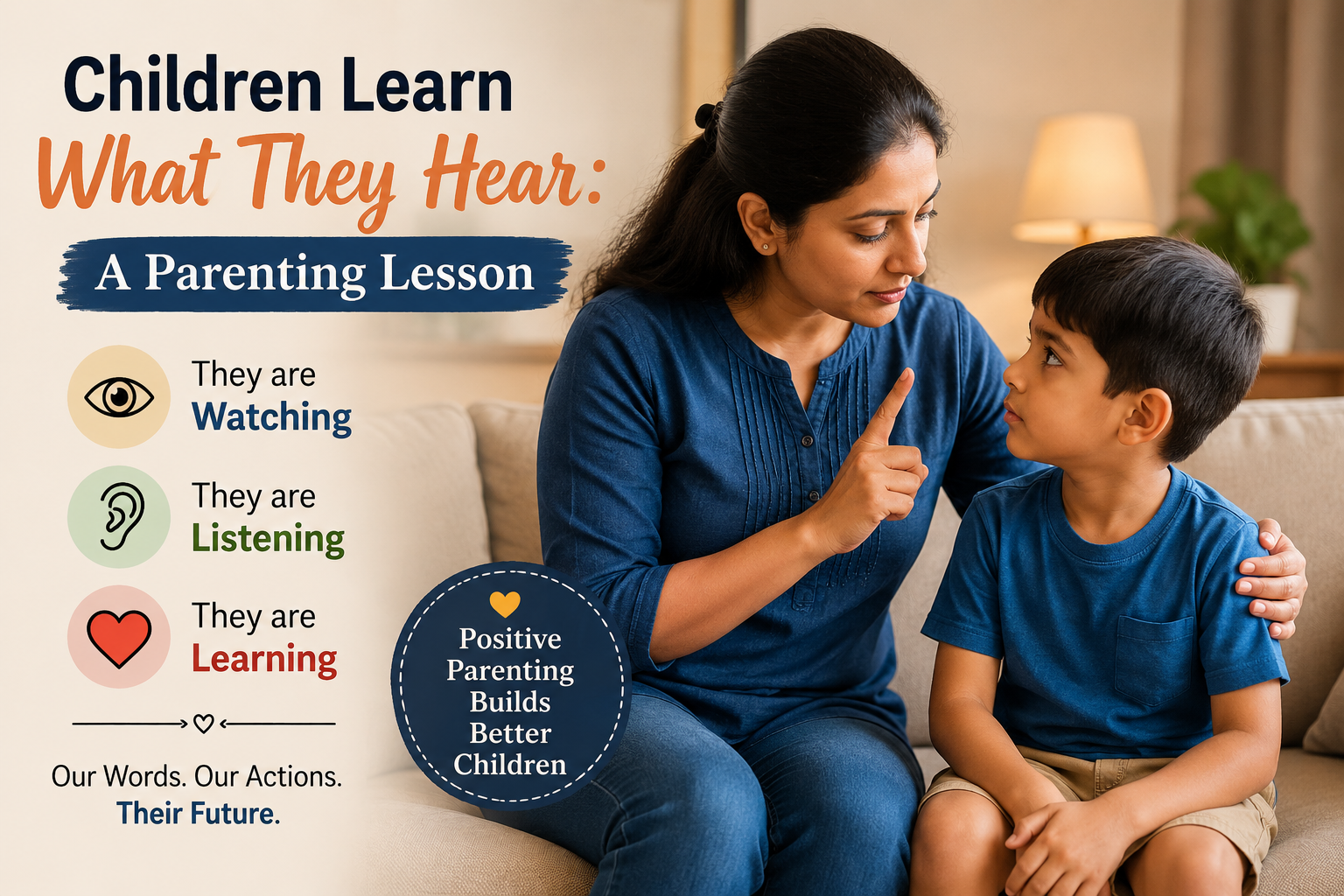
Children learn by watching and listening. Discover a real parenting experience and learn how to guide children away from bad language.

Parenthood is a beautiful journey, but every stage brings new experiences and new challenges. Some experiences fill our hearts with happiness, while others leave us worried and confused.
Before becoming parents, many of us do not think too much about the things we do in our daily lives. We may not be careful about the arguments we have with our spouse, the words we use when we are angry, or even the content we watch on television.
But after becoming parents, things change.
We become more careful—and rightly so.
We should always remember that little eyes are watching us.
Our children watch what we do, listen to what we say, and often try to copy us. This is completely natural because children learn many things by observing the people around them, especially their parents.
As parents, we have a responsibility to guide them towards the right things.
We cannot change what happened in the past, but we can certainly become more aware of our actions. If there are certain behaviours or words that we do not want our children to learn, we should try our best not to repeat them in front of them.
Children Learn by Watching and Listening
Children are naturally curious. They observe everything around them.
However, they do not have the maturity to understand the difference between good and bad. They may hear a particular word without knowing its meaning and still remember it.
Sometimes, they simply connect a word with an emotion or situation.
For example, if they hear someone using a particular word while feeling angry, they may assume that the word should be used whenever someone is angry.
They do not understand whether the word is appropriate or inappropriate.
This is why parents need to be careful about the language and behaviour children are exposed to.
At the same time, if our children learn something inappropriate, we should not immediately react with extreme anger. Children are still learning.
Scolding them may not always solve the problem. Sometimes, it can create another problem.
Instead, we need patience.
We need to understand where they learned something and then calmly help them understand why it is wrong.
Today, I want to share a personal experience that made me realise just how carefully children observe the world around them.
A Morning at School Drop-Off
Like every morning, one day my husband and I went to drop our children off at school.
Anyone who regularly travels during school hours probably understands how stressful the traffic can be. Every morning feels like a struggle to reach school on time.
For me, it is stressful.
But for my husband, it is probably even more difficult because he is the one driving!

That particular morning, the traffic was terrible. It was almost like a complete deadlock.
Everyone seemed frustrated.
There were traffic police officers trying to manage the situation, but the traffic was so heavy that it was difficult for them to control everything properly.
Some people became impatient and started using harsh words.
Two bus drivers were continuously arguing about who should go first. As their argument became more heated, they started using slang and inappropriate words.
My husband and I tried to ignore their conversation.
But we did not realise that someone else was listening carefully.
My little son.
At that moment, we had no idea that those words would remain in his memory.
The Word That Shocked Me
Two days after that incident, my son returned home from school and started playing.
It was afternoon, and I repeatedly asked him to go and take a bath.
I needed to feed him afterwards, and then I had to leave to pick up my daughter from school.
But he continued playing and ignored me.
I asked him several times.
Still, he did not listen.
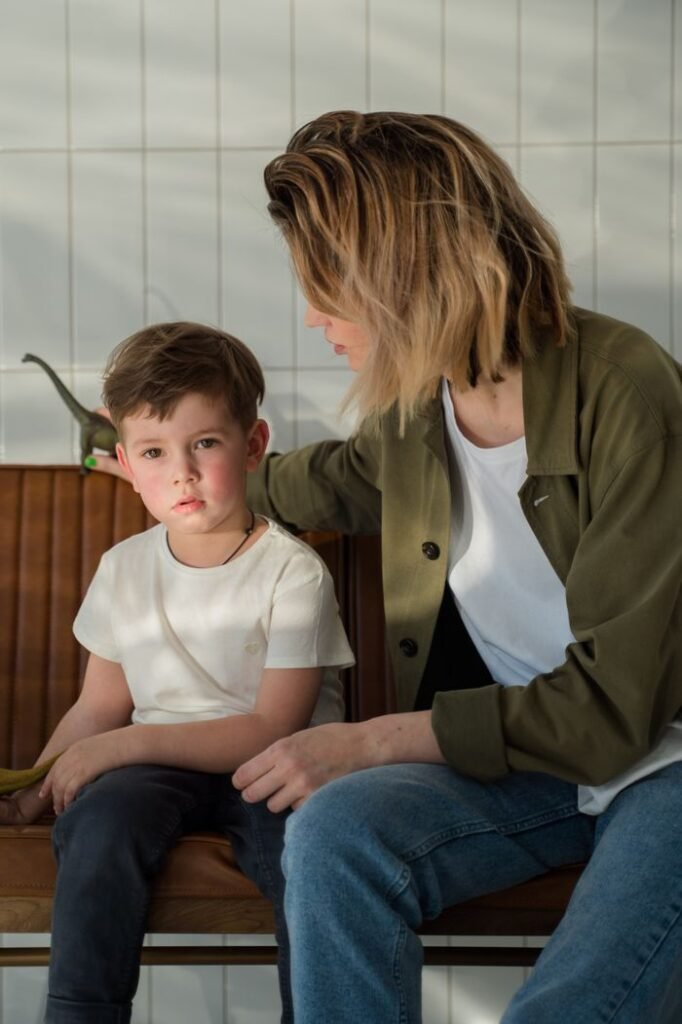
Finally, I lost my patience and scolded him. I told him firmly to go to the bathroom.
Suddenly, he said something.
At first, I could not understand what he had said.
So, I asked him again.
He refused to repeat it.
After asking him several times, he finally said the word again.
And I was shocked.
It was one of the slang words I had heard the bus drivers using during their argument.
My first reaction was anger.
Honestly, I shouted at him.
Sometimes, as parents, we react immediately when we hear something unexpected or upsetting from our children.
But after a few moments, I realised that shouting was not the right solution.
Instead of scolding him, I needed to understand something important.
Where had he learned that word?
So, I calmed myself and asked him gently,
“Please tell me, where did you hear this word?”
At first, he hesitated.
Then he told me that he had heard it during the argument between the two bus drivers.
I was genuinely surprised.
It had been two days, but he still remembered that word!
I asked him another question.
“Do you know what this word means?”
His answer left me speechless.
He said he did not know the meaning.
He only knew that when someone was angry, they used that word.
That was the moment when I realised something very important.
He did not understand that it was a slang word. He did not know its meaning. He had simply connected the word with anger.
Why Scolding Was Not the Answer
At that moment, I understood that simply scolding him would not solve the problem.
He was still a small child.
He had heard a word.
He remembered it.
And he copied it.
That was all.
So, I calmly explained to him that it was a bad word and that he should not use it.

I also discussed the matter with my husband, and he explained it to our son as well.
My son listened to us.
However, sometimes, when he became angry, he used the word again.
Every time it happened, I wondered how we could help him completely stop using it.
I knew that constantly shouting at him would not help.
Then, unexpectedly, something happened that helped us.
The Unexpected Solution
In Bengali culture, there are many fantasy stories about ghosts and supernatural characters.
There is a particular female ghost character that appears in several Bengali stories, and my son is scared of her.
One day, he was watching a video about this ghost.
In the story, there was a little boy who did not listen to his mother.
His mother warned him that if he continued misbehaving and refusing to listen, the ghost would come at night and catch him.
But the boy was stubborn.
He continued his mischief.
Later that night, the ghost came to catch him.
However, after the mother’s request, the ghost finally left the boy. Before leaving, she warned him that if he did not listen to his parents again, she would return.
After that experience, the boy changed.

He was still naughty, but he started listening to his parents.
After watching the story, my son asked me,
“Will the ghost come again to catch the boy?”
I replied,
“No. The boy is listening to his parents now, so the ghost will not come again.”
My son remained quiet for a few moments.
Then he asked,
“Can the ghost come to our house too?”
I replied,
“Of course. If you do not listen to us, she may come.”
Without wasting a moment, he immediately said,
“I will listen to you!”
At that moment, something came into my mind.
I remembered the slang word.
I had been thinking for days about how I could help him stop using it.
So, I said,
“Okay. Then promise me that you will never use any bad words again. Otherwise, I will tell the ghost.”
He immediately replied,
“Yes, Mom. I promise that I will never say any bad word again.”
And surprisingly, that promise worked.
Every Child Is Different
From that day onwards, he stopped using that slang word.
Sometimes, if he accidentally said it, he immediately apologised.
Slowly, he stopped using it completely.
After some time, he even seemed to forget the word.
This experience taught me an important lesson about child behaviour and parenting.
Children are always watching and listening.
They may learn things from their parents, family members, television, friends, strangers, or even a random argument on the road.
We cannot control everything our children hear or see.
But we can control how we respond when they learn something inappropriate.
Instead of immediately becoming angry, we can try to understand:
- Where did they learn it?
- Do they understand its meaning?
- Why are they using it?
- What is the best way to explain the situation to them?
Every child is different.
Therefore, parenting strategies cannot be the same for every child.
What worked for my son may not work for another child.
As parents, we know our children better than anyone else. Sometimes, we need patience, creativity, and understanding to handle difficult situations.
This was my experience, and I wanted to share it because I know many parents may have faced similar situations.
Perhaps your child has learned an inappropriate word from school, television, friends, or somewhere else.
How did you handle it?
I would genuinely love to hear about your experiences.
Please share your parenting experiences in the comment section. Your experience may help another parent who is facing a similar situation.
After all, parenting is a journey where we are constantly learning—just like our children.