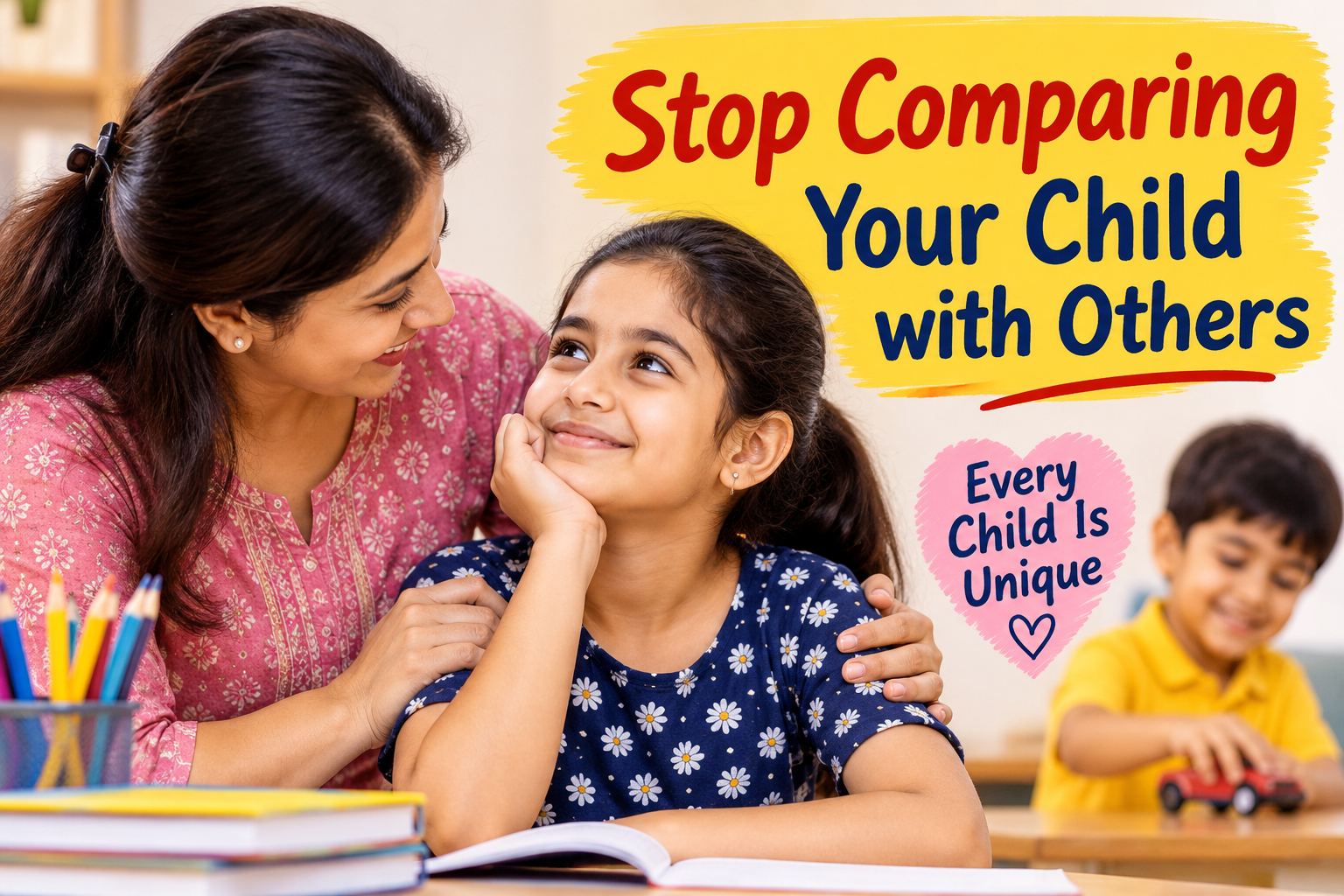
Comparing children with others can affect their confidence. Learn why positive parenting and encouragement matter more than comparison.
When we become parents, there are lots of things we need to take care of. Sometimes we do something, but later we realise that we shouldn’t have done it. Actually, the truth is that we parents are human beings too. Every human being makes mistakes, and so do we. But we should also learn to recognise and rectify those mistakes.
One thing I have noticed among many parents is that they often compare their children with other children. I also used to do the same before. However, one of my friends helped me change my perspective on this issue.
Sometimes, comparison can be healthy because it works for some children, but not for all. Some children take it positively and try to improve themselves by following the example of another child. But some children may take it in a completely different way. They might start thinking that their parents like the other children more than them. In such cases, the outcome can actually be worse.
So, is comparing children with others always helpful? I don’t think so.
We should always remember one thing: every human being is unique, and children are no exception. Their thought processes, interests, abilities, and ways of learning are different. Parents can understand their children better than anyone else, so they should choose the approach that works best for their children.
First, I will share my friend’s son’s story, and then I will share more of my thoughts on this issue.
A Lesson I Learned from Another Parent
That day, I visited my friend’s home. My children were at school, so I went to her place to spend some time with her. She has one son, who was also at school at that time. However, when he returned from school, I was still there.
After entering the house, he informed his mother that he had received his Maths class test marks. Like other parents, my friend asked him how much he had scored. He told her his marks. Then she asked him what the highest mark in the subject was. He replied to that question as well.
After that, she didn’t ask him anything more. She simply told him, “So, you have understood that you need to improve your marks. Please go through your mistakes and pay attention to your weak areas.”
Until then, I had seen many parents who not only asked their children about their marks but also asked about their friends’ marks. After that, they compared their children’s scores with those of their friends. Not only that, they also started asking their own children why they had scored less than another child.
But is this really helpful?
I also did the same thing before, and I admit it. But I felt that this approach wasn’t working. I wasn’t sure whether it actually helped my children improve. So, I shared my thoughts with my friend and asked her whether she followed the same approach.
She replied, “I never do this because there is no reason to compare your child with others. What is important is understanding how much improvement your child needs to make in a particular subject. That’s why I asked him about the highest mark. It helps me understand how much he needs to improve.

I also never ask him who got the highest marks because that isn’t important. What matters is how much improvement my son needs to make. It doesn’t mean I want my son to get the highest marks. I just want him to understand his mistakes, learn from them, do better, and become more careful in the future.”
I was listening to her very carefully, and I really liked her perspective.
Every Child Is Unique: Stop Comparing Their Abilities
This is true. Every child is unique. They are completely different, just like the five fingers on our hands.
Some children are interested in studies, some are interested in sports, and some are interested in music. We can’t expect every child to excel in all these areas. Of course, there are exceptions, but in general, different children have different interests and abilities.
So, as parents, we should encourage our children to improve themselves. But we shouldn’t make them feel that they have to be the best in a particular field simply because their friends are doing well in it.

Just because their friends are doing great doesn’t mean they also have to excel in the same area.
We should remember one thing: not all students in a class will secure the first position. But that doesn’t mean the others are bad at studies or incapable of achieving something in life.
Every child has their own strengths and weaknesses. Some may need more time to understand a particular subject, while others may grasp it quickly. Instead of comparing their performance with others, we should encourage them to work on their weaknesses and recognise their strengths.
Encourage Children Instead of Criticising Their Marks
We should always encourage our children to do better. As they grow and become more mature, they will gradually understand their abilities and find their own path.
We should also be careful about the words we use when discussing their scores or marks. Instead of making negative comments, we should try to speak positively and motivate them to improve.
Positive encouragement can help children develop confidence and the willingness to work harder. On the other hand, constant criticism and negative comparisons may make them feel discouraged, depressed, and less confident.
Our intention as parents is never to hurt our children. We want them to succeed and do well in life. But sometimes, without realising it, our words and actions can have the opposite effect.
Therefore, we should be mindful of how we motivate our children. Rather than making them feel inferior to others, we should help them understand their mistakes and believe in their own abilities.
I Am Still Learning in My Parenting Journey
I always admit that, throughout my parenting journey, I am constantly learning. Sometimes I learn from my children, and sometimes I learn from other parents.
Whatever I learn, I always try to share it with other parents so that they can look at things from a different perspective.
Now, I practise the same lesson in my life with my children, and I am getting better results.

I believe that parenting is not about being a perfect parent. It is about learning from our mistakes, understanding our children, and making changes whenever necessary.
Instead of comparing our children with others, let’s encourage them to become better versions of themselves.
What Is Your Opinion?
Perhaps you have a different opinion on this matter, and that’s absolutely fine. Every parent has their own experiences and ways of raising children.
But please do share your views in the comment section. I would definitely love to learn from you too. Your experiences and suggestions may also help other parents who have questions or are struggling with similar situations.
Let’s learn from one another and make our parenting journey a little better!